
|
|
The good, the bad, AND ...??
...an overview of sidecars and driving one
Sidecars and trikes have been around for a very long time, actually, since the 1800's.
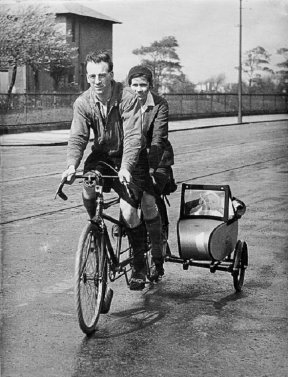
Below are a few old photos. First, an early bicycle rig. Bicycle rigs were also built, long ago, with 1 cylinder gasoline engines. Even steam powered bicycle rigs were built.
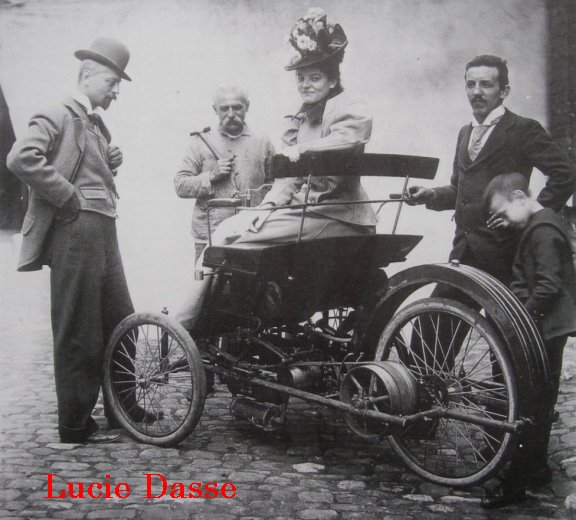
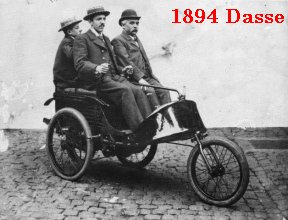
The photos below are of the Dasse water-cooled trikes. The ones with Lucie Dasse in them are the 1895 model Dasse. Lucie was the
first female driver in Belgium. Lucie was the wife of
Gerard Dasse, of Dasse Motors, Verviers, Belgium. They primarily manufactured cars, from 1894 to 1930. An offshoot of the company existed until 1956. Lucie's brother Armand was well known to the early racing world. Looking at these photos; the joints and shaft pillow blocks, and many other items, were commonly available items then. I have been unable to give you information on the engine itself.

Sidecars were widely used in Europe, & still are. In the USA, sidecars and trikes have always been relatively rare. The most common was the old Harley Davidson trike with the 45 engine, used by Motor Maids (who wrote parking citations in larger cities). Today, to those who see them, a sidecar rig (and, to a much lesser amount, trikes) often creates a response that is a mixture of emotions, nostalgia, good times, etc. Most everyone likes a sidecar rig and its pilot, the sidecarist. I have never heard the word trikesit used.
Sidecar rigs carry more than a motorcycle can. They don't fall down on slippery roads. Most sidecar outfits do fine on slippery and even snowy roads. Sidecars do not carry the stigma that motorcycling in general carries with the public. The public LIKES sidecars, WANTS to stop and chat, and often WANTS to have you take them for a drive! MOST sidecars have QUIET exhausts, and the public LIKES that! Sidecarists also tend to be extra courteous and friendly.
Sidecar rigs are used all over the world for commercial purposes, for basic transportation, and for just plain fun. In a number of countries, sidecar type bicycle rigs are in wide use for a wide variety of purpose.
Spouses may prefer a sidecar to the rear pillion of a motorcycle.
It is quite possible that your riding season will be extended to year-round, if previously restricted due to weather conditions.
Sidecar rigs in Asia, India, and China are considerably different. Typically they are a SMALL engine (low displacement) motorcycle with a platform sidecar, and are built to haul the entire family AND a LOT of goods, all at the same time, as cheaply as possible.
An image folks in the USA have, is that motorcycles are typically not workhorses, but toys of some form or another, & that a sidecar rig is a substitute for motorcycles for old or handicapped folks not capable of handling two-wheeled motorcycles. There can well be considerable truth in those ideas ...but it is hardly the full story. I'll attempt to tell at least SOME of the full story.
There is a small, or at least modest percentage of motorcyclists who commute on their bikes, some year-round, some don't own cars. A much larger percentage use motorcycles for short term fun, short rides, some much longer touring rides. Longer touring rides are relatively common for BMW bike riders, including sidecarists. There are the yearly vacations or other trips. Sidecars can and do carry much more than two-wheelers, and this can include the spouse, children, and/or family dog(s), not to emphasize the mention of the much larger cargo carrying capacity. While many motorcyclists put their motorcycles into storage in the Winter, many sidecarists enjoy driving them in Winter...after all, sidecars don't 'fall down' when in snowy, icy, muddy conditions. In the USA in particular, sidecaring is, or is nearly, a way of life for many, and sidecaring is JUST PLAIN FUN, especially for those who have ridden (we call it DRIVING them) enough to have a solid opinion.
As I noted earlier, sidecars were always popular in Europe, but not so much in the U.S. (since somewhat before and during the Depression of the thirties). In the U.S., 'trikes' were used for many decades for all sorts of things, including delivery of mail, goods, pizza, whatever. Sidecars were used a lot prior to the Depression.
The Harley Davidson 'trike' was popular, with its "45" engine, in the Eastern Seaboard areas; but was also used out West for traffic/parking control by the police, and sometimes for a delivery vehicle or for everything from tamales and hot dogs to ice cream sales. In the last several decades, trike conversions have become quite popular, with conversions using a Harley Davidson or Honda motorcycle being exceptionally valued. Trikes have few advantages over sidecar rigs. They are, more or less, balanced in operations to the left, to the right, ...and straight-forward (as in braking). They can be quite wide, but usually not as wide as a sidecar rig (especially a 2 person type). Trikes are easier to learn to operate. Today, there are new vehicles being manufactured that have two forward widely separated wheels, and one or two in the rear, closer together. The Spyder is quite popular.
Sidecar rigs have some pronounced advantages. One huge advantage is the passenger/cargo area, and there are numerous other advantages. I won't get any deeper into these ideas and variations, motorcycles to trike or sidecar, trike to sidecar, sidecar to trike, and the Spyder configuration, etc.. Today, all sorts of interesting variations on motorcycles ...very broadly speaking ...are available.
There have always been sidecar groups in the U.S. Since the late 1980's, sidecars have become more popular again, & this trend is likely to continue. More sidecar outfits are on the road today than just a few decades ago. Complete sidecars rigs are manufactured by only a few world-wide companies today. Complete sidecar outfits, from the motorcycle frame and engine right to the finished drivable product, are produced in China, Russia, and by Harley Davidson in the USA (prior to ~2009, HD only supplied the sidecar and the bikes, the HD dealerships mated them). HD is also again producing trikes (but modernized). My suspicion is that considerably more trikes are produced than sidecar rigs, but I have no specific facts to back that up.
A motorcycle with a sidecar attached has numerous names, and sidecar folks themselves use terms like the following to describe either the sidecar, or the entire rig, or the tug, etc:
Rigs; Sidecars; Sidecar Rig; Hacks; Chairs; Outfits; Combinations! Gespanne is also used, although it literally means harnessed. Every one of these terms has been used to describe the entire sidecar rig.
Sidecar rigs have been designed & built from simple and conventional to complex or even outrageous, and ridden (actually we sidecarists usually say they are DRIVEN) in almost every sort of imaginable way. Some rigs have the motorcycle still capable of leaning, see https://bmwmotorcycletech.info/flexit.htm, some have this down so well that the motorcycle handles just like, or nearly, a motorcycle. Sidecar rigs have been made in a very wide range of versions. There are sidecar rigs that are specifically designed for the handicapped; even for those with only one...or NO...legs. Many a sidecar rig has been made with a platform in place of a regular passenger 'tub/chair'; in which a handicapped rider will keep a wheelchair, and the rig is set up for the driver to drive the rig from the wheelchair located on the chair area platform...or, even from the motorcycle. Some designs are exceptionally clever. Over-all, I would say that the majority of sidecar rigs are in use to extend the motorcycle riding days for the older rider. The second large group would be those who still ride 2-wheelers and want the sidecar experience too.
Some sidecar rigs have two wheel drive, the rear wheel of the motorcycle (the motorcycle of a sidecar rig is traditionally called 'the tug') and the sidecar wheel. The most well-known is the URAL, made in Russia, which are also available in conventional single wheel drive.
Some rigs are double wide, some 'chairs' are hearses, dog or hay or whatever carriers ...or other types of cargo carriers, anything you could dream-up, including detachable boats. Some are made so quite a few people can be carried, something like a miniature bus. This website has some really strange sidecar rig photos on it, to give an idea of what has been done. While some of the photos of sidecar rigs are scattered throughout this website, here is one page that has some 'interesting' ones: https://bmwmotorcycletech.info/sidecar-humor.htm
Here are a few more(of many links I have):
This site has a fabulous collection of hundreds of photos of old 3-wheelers.
http://www.3wheelers.com Try clicking on the several galleries near the top.
http://www.motorcycle-memories.com/ This is a source for many photos of old time motorcycles and sidecars, etc.
http://www.side-car-club-francais.com/ This is a source for photos, etc., of sidecars listed by manufacturer's name. EXCELLENT source!
There is an entire sidecar section of articles on this website, near the very bottom of:
https://bmwmotorcycletech.info/technical-articles-list.htm. All of my sidecar-only articles begin with SC-.
Having a sidecar may require the motorcycle to be serviced somewhat more often. Properly done sidecar rigs do not have excessive maintenance requirements. The maintenance on the sidecar itself is usually low, mostly just servicing the wheel bearings now and then; or, bleeding brakes.
Sidecar outfits do not handle like cars, do not handle like motorcycles, do not handle like trikes, and can be, like any vehicle, dangerous for the novice. Those with no experience with sidecar rigs should not venture out onto busy road traffic. Novices/Newbies, whether very experienced motorcyclists or not, should take instruction, preferably formal, but a regimen of learning and practice will do. Information on setting up and also on driving sidecars, in depth, will be found on the Internet, at:
https://sidecar.com This is the site of the USCA. If you can find Hal Kendall's literature on this site, you will want to print it!
BTW.....
One is said to RIDE a motorcycle, and DRIVE a sidecar outfit. The below link is not an article on how to drive one; although I have hints later and in other articles. GOOD articles on how to drive a rig are available in booklet/book form; as well as free on the Internet from such as the Ural folks, and from the late Hal Kendall, see link in just above paragraph. There is some very good information about sidecar handling, and use of sidecar brakes, here:
https://bmwmotorcycletech.info/misclsidecartech.htm
In general, countries where driving is on the right, as in the U.S., have sidecars mounted on the right side of the motorcycle. The reverse is also true, sidecars are mounted on the left in England, etc, where driving is done on the left side of the road. Having a sidecar mounted on the 'wrong' side in a particular country can be dangerous, as your field of view for oncoming cars is poorer the closer you are to a vehicle in front of you. In addition, an oncoming car might be more inclined to turn in front of you, 'just past' the end of that truck, bus, etc., in front of your sidecar rig ...because they did not see you easily enough. If you think about this, no matter if the sidecar is on the right or left, do not drive too close to the vehicle in front of you. This is also good advice for a motorcyclist, and for the two-wheeler, in the USA, it is best to not drive in the right side of your lane, if there is one or more lanes to your left. An experienced sidecarist can fairly easily transition from one country situation to another; and same for 2 to 3 to 2 wheels. Some motorcyclists with no or little sidecaring experience, especially without training, have said that it is difficult for a motorcyclist to transition to a sidecar rig, and vice-versa. I BELIEVE THAT IS NOT TRUE!
You will likely find the initial sidecar experience exhilarating, and while you will need training/practice, you will not likely have problems going back and forth between a motorcycle and a sidecar rig. If transitioning back to a motorcycle, do remember to put down your left foot at a stop sign!
Sidecar rigs place a lot of forces onto a motorcycle that the motorcycle may well not have been designed for. These forces must be taken into account during the design of the frame, subframe, attachments, suspension, tires, etc., as pertinent to the particular motorcycle. Some motorcycles will require many modifications, including a subframe. Some actually require an entirely new frame. One could write a huge number of words on all the variations.
Sidecars have been made in all sorts of sizes and designs. Some very small ones fit something like a Vespa scooter, to something as large as for the largest Harley-Davidson or Honda product. Sidecars have been made that are capable of carrying half a dozen+ kids! As an example, the school-bus types. There are bicycle-based sidecar rigs, and these are quite commonly seen in the Far East.
Things to know & consider:
A
sidecar creates a noticeable drag component. This comes from air resistance as well as the sidecar tire friction with the road surface. While that is true, there are also similar effects on the tug, in the opposite direction, and these forces do tend to cancel each other, more or less, with the bias still being to the sidecar. That is why rig alignment and setup is critical for a really nice sidecaring experience. Often, many small adjustments, one at a time, are made until the results are most pleasing.More horsepower is needed & will be used when driving with a sidecar, for the same speeds and conditions on a 2-wheeler. Fuel mileage will decrease, sometimes considerably, particularly if you regularly travel at higher speeds. A rigidly-mounted sidecar rig is somewhat more susceptible to moving to one side of the road or the other, due to the crown and slope of the road (and, slope and crown on even flat-appearing freeways can change between your lane and the one next to you). You will gain a better ability to judge the crown and slope of roads! You will likely be more thoughtful on selecting road lanes. While some sidecar rig designs are adjustable for such effects, perhaps electrically via a control on the bars, most are not, and a properly set up rig doesn't need the adjustability by the driver. Still, handling can be more or less constantly changing, depending on the road. A properly set-up and aligned conventional sidecar rig will have a minimum of these effects, and is normally set up for the more frequently-traveled-roads.
When one drives a sidecar rig, one will find that going faster means greater drag from the sidecar, which tends to make the rig turn towards the sidecar ...which you must compensate for, by electric lean, a bit more muscle, or some other method, depending on the setup. In some respects, this is all more like driving an automobile. Most sidecars are aligned and set up so that at the normal speeds and loads used, they track, more or less, straight down the road. A well-set-up sidecar rig WILL drive nearly the same from slow to high speeds. Such alignment can take some time to achieve, playing with adjustments one at a time.
In a more basic driving description, one steers a sidecar rig just like a car ...up to a point.... BUT....when the sidecar outfit is making a turn towards the sidecar, if the turn is tight enough, and/or fast enough, forces will eventually cause the sidecar wheel to come off the ground. In a car, if a sharp turn is made at sufficient speed, the same thing will happen, more or less. A small amount of sidecar wheel lifting is of NO concern, wheel up some is normal, and there is no change in steering ...there is NO steering reversal ...NO countersteering is needed. Literature saying otherwise is WRONG! You need to practice. It is not dangerous ...any danger is likely only IF YOU go way overboard in your practice depth....or, you panic. In actuality, sidecar driving to the wheel lifting point is a LOT OF FUN!
At some point, generally if the driving style is QUITE brisk & aggressive, if the wheel comes WAY off the ground enough (this will be VERY steeply off the ground), the motorcycle with the sidecar attached, will want to GO THE OTHER WAY! This is at the balance point. The sidecar wheel will be WAY high off the road. At this point you can have steering reversion. Your rig has now decided to be a motorcycle. You are riding to one side of center of the tug tires ...and seriously leaning ...just as in a quite hard turn on a motorcycle. This IS dangerous for the INexperienced; and even for experienced sidecarists, because this situation is almost never practiced. Stunt drivers do it, in straight lines or turns. There is NO GOOD REASON TO DO THIS SORT OF STUNTING or SHOW-OFFING.
Many folks describe any time the sidecar wheel is not in contact with the surface, as "Flying The Chair", but REAL flying of the chair is to the that just-mentioned tip-over or balance point, the center of gravity being, at that point, over the line between front and rear wheels of the tug. You have to be an idiot, or a show-off, to get to that point. But, Flying is the word used, quite often generically, for any time that the chair wheel is off the ground ANY amount. It is wrong to use it that way, but that is how it is used by many, if not most. Just the sidecar wheel bobbling on and off the ground is NOT AT ALL truly flying the chair. In fact, it is NORMAL at times. There is in-depth information on this website: https://bmwmotorcycletech.info/sidecarcountersteering.htm
It is UNlikely for the normal average, even spirited/aggressive sidecarist, to get to an angle as to truly fly the chair at the tip-over balance point.... and thus experience true steering reversion. Even if you did reach that point, instinct may have you counter-steer out of it!
In normal driving in sharper turns or big sweeping turns (and even sometimes straight ahead in exceptionally strong gusty winds at highway speeds), the sidecar wheel may lift a bit, and backing off on the throttle provides instant re-contact. There is NO steering reversion, contrary to what some writers would have you believe. THEY ARE WRONG! A sidecar rig, with the sidecar wheel off the ground in normal such usage, is 'steered' normally, NO steering reversion. See later herein, with my disagreement with ONE small section of some published booklets ...or, just go to the link, above. The TRUTH of the matter, is that most all sidecarists hardly lift the sidecar wheel much, and ignore it, or don't even feel it.
At this point I have covered turning towards the sidecar, now I will get into turns in the other direction.
When you turn away from the sidecar, if the speed and turn is sufficiently aggressiveness or sharp, or some combination, you could cause the sidecar nose to dig into the ground, causing a spectacular flip and serious accident. If you picture this in your mind you will see that as the sidecar outfit is steered away from the sidecar, the motorcycle rear suspension will EXTEND and depending on various factors such as how much the sidecar wheel axle is ahead ('leading') of the motorcycle rear axle (if any, ...some Harley and other rigs do not have 'wheel lead'), the motorcycle suspension could be extending more and more ...and the rear wheel may actually lift off the ground before you dig in the nose. Most sidecarists will experience the feeling of the rear suspension rising in a turn away from the sidecar, and will feel the rig bobbling, for lack of a better word, as the rear suspension lifts enough, and the sidecar nose moves some towards the ground. This is a signal to either back off your aggressiveness or to reduce speed. I avoid getting to a serious point of sidecar nose going down too much. The reason is that it does not take too much more (depending a LOT on the particular rig) to cause the nose to dig-in. This can happen VERY SUDDENLY. As previously, unless you are really being overly aggressive, you just don't get to this point, because the feel is very noticeable as you unload the tug rear suspension.
Having an excessive amount of weight at and behind the motorcycle rear axle, such as a passenger on the rear of the motorcycle seat, adds INERTIA when turning, and in this situation one must be EXCEPTIONALLY careful, and it is best to avoid such situations. It is definitely best to put passengers in the sidecar, where their weight CONSIDERABLY HELPS handling on turns TOWARDS the sidecar. The effects of a passenger on the motorcycle seat is potentially dangerous, no matter which way you are turning, and most of us experienced sidecarists avoid ever doing it, except, perhaps, in very slow going, or parades, etc. Sometimes passengers are carried on the tug seat AND in the sidecar. Safety always comes first!
Sidecar wheel leads of zero to 12 inches are common. The more LEAD the sidecar wheel is forward of the tug rear axle, the more the tire wear, due to scuffing on turns. As in ALL sidecar things, the lead amount is a compromise. Typical leads are 6 to 8 inches. The selection of wheel lead when building a rig is a subject unto itself.
Driving a sidecar rig vigorously & aggressively ....and/or just competently ....will require more skill than simple motorcycling. Most folks learn to handle a sidecar rig competently, decently, and safely, after just one weekend of instruction & practice. They won't be competent for very aggressive and very fast driving, but they will be safe, and be having A LOT OF FUN. The learning comes faster if the new driver already knows how to ride a motorcycle, just one of the reasons is that the new sidecar driver does not have to learn about where and how to use the motorcycle controls.
For the highly experienced and aggressive sidecar driver, lest you might be told or believe otherwise, a competent driver with a very high performance 'rig' may outperform a solo motorcycle, even in the twisties.
Some sidecar outfits require a fair amount of muscle energy to drive, particularly in the mountains or other twisty roads. Thus, some rigs can be especially tiring on trips, and you may also find that your usual motorcycling road speeds will be reduced, for a variety of reasons. You may find that if 700 miles is your limit any day on a solo bike, that 500 is your limit on a sidecar. In general, sidecar rigs with car tires, which are considerably wider than motorcycle tires, take more energy to muscle-around.
Do not enter into the world of sidecars without a LOT of pre-investigation, pre-planning, and reading and discussions! Try to get rides in several types of sidecar rigs, and try to have a few people 'loan' you the sidecar rig, whilst they sit in the sidecar, and talk you through some mild beginner-type driving in big open areas.
Sidecar rigs vary considerably, even when aligned/setup properly. A general statement that I believe true, is that sidecar rigs are more heavy-handling than a two-wheeler. You may or may not like the handling. If you are already an experienced motorcyclist, you will find that steering is very different, leaning (if you do it) is different, braking is different, throttle and brakes do things a bit differently, and emergency braking or maneuvering is different. It is actually more difficult to drive a sidecar rig well, than a two-wheeler. On a practical basis, however, the sidecar rig can be exceptionally useful for shopping, touring, sight-seeing, carrying the spouse or dog or kids or combination of those things. Many folks own both a 2-wheeler and a sidecar rig. I do.
Here are some resources:
1. Driving a Sidecar Outfit, a thickish booklet.
2. Driving the Ural Sidecar Motorcycle, a thickish booklet, most any Ural Dealer has one.
My disagreement with the "Yellow Book", as it is called due to the color of the cover(s) (& the URAL book, which is practically the same information, inside) .....is with (at least in early versions of the books) David Hough's wording (& again, my total disagreement is JUST with the descriptions on steering reversion) (&, generally, no disagreement at any other place with these books). I think the way flying the sidecar & reversion is presented is deadly wrong. Other than that, these are excellent books, and WILL help you quickly learn how to handle a rig. The area of my disagreement, on steering reversion, may be fixed in a later edition ...but I presently do not know. See https://bmwmotorcycletech.info/sidecarcountersteering.htm that is an article on the subject, on this website.
Join the United Sidecar Association (USCA). Perhaps obtain a copy of "Riding with a Sidecar". The USCA has sidecar rallies, scattered across the lower 48 of the USA. They can be a lot of fun. In 2009, the USCA National Sidecar Rally was held at Lake Tahoe, California, and my wife and I were the organizers and hosts. If you are interested in sidecars, and would like to see a LOT of sidecar rigs at one time at one place, DO go to one of the major sidecar rallies, if you can. You will find yourself looking, asking, having many conversations, etc. You may see me there.
https://bmwmotorcycletech.info/sidecartech.htm on this website for some URL contacts, etc. ...for the literature you will likely want.
Here is a link for the training folks at Evergreen: http://www.esc.org/ I have a few disagreements with the Evergreen organization and its policies, but you will be prepared, if you read the free downloaded booklets from http://sidecar.com.
� Copyright 2023, R. Fleischer
Return to Technical Articles LIST Page
Return to HomePage
Last check/edit:
Saturday, August 19, 2023