|
|
The ads above are Google-sponsored;
clicking on them at every visit helps support this website!
Clicking on something inside an advertisement helps even more!
� Copyright 2021, R. Fleischer
I suggest you read article 51-C:
https://bmwmotorcycletech.info/oilessay.htm
It has information about engine oils that are becoming a problem for Airhead owners. You will be better informed. It also has a very much in-depth discussion of how oils really work, and much more, including more information about changes.
I STRONGLY suggest you read article 51A: https://bmwmotorcycletech.info/Oil.htm. I suggest you read that entire article AFTER you read this one, 51B. Take a look at the other articles beginning with number 50 and 51.
It is important for an Airhead owner to have a basic understanding of what is in 49 through 51D.
This article, below, glosses-over the highly detailed information provided in article 51-A ...particularly about the oil canister and the so-called $2000 O-ring, the paper gasket, and the metal shim.
The earliest Airheads, when not equipped with a BMW cooler, came with a three bolt outer plate, and an inner metal cap cover held to the canister center pipe by means of a single large bolt. That system is nearly foolproof. At least one or more Haynes books are wrong in not even illustrating this version! ....and Haynes wrongly labeled a later models sketch for the /5.
For those Airhead models having an oil cooler, the filter canister, central pipe, and the outer cover were changed, and there is no internal metal cap cover and thus no single bolt at the internal cap cover. BMW later changed the oil filter chamber and cover parts for ALL models, and they became much more similar to the parts used for the cooler models. The general parts, with minor changes, were for both cooler & non-cooler. BEWARE of factory sketches, and BEWARE of 'information' in Clymers and Haynes manuals!!!
Some notes on engine oil changes for your Airhead:
This is simplified information, perhaps even an introduction, because it is not intended to be 'how to do an oil and/or filter change' and have 'all the small but important details'. Please read the other oil articles, in particular: https://bmwmotorcycletech.info/Oil.htm. NOTE that the O in ...Oil.htm ...is capitalized.
In my opinion, for a normal engine oil (only) change (not changing the filter), I'd not drain the cooler. I'd not remove the outer cover at all. I would not loosen the banjo bolts if you have a cooler model. I would check the banjo bolt tightness with a torque wrench, and check that neither hose was touching the inside of the fairing, if you have a fairing. If a hose was touching your fairing, I would loosen the associated banjo bolt only just enough to allow you to reposition the hose, with mild force on the banjo metal. If you have to remove or greatly loosen the banjo, then replace its two washers (two gasket washers per banjo). You must re-torque the banjo bolt to specifications. DO NOT reuse the 4 solid aluminum style washers. See my hardware or other articles on the proper washers (gasket rings)as the solid aluminum ones are not the best to use.
The cooler will drain some when you undo the banjo bolts for a filter change. Further draining is not necessary. The amount of old oil left in the cooler radiator is rather small. If the cooler drains some, you should properly refill it, which helps protect it against oil pump output surges. That's a simple way of explaining this.
There is more than one type of outer oil filter covers. The very earliest Airhead outer cover was a flat plate. Inside was a cap cover and a central bolt. The outer plate on that version REQUIRES a single paper gasket.
When an oil cooler is installed, the original type used a two-port outer plate of more complexity, and there was a cylindrical part on the casting containing a thermostat. The thermostat opens when the casting and oil get hot enough to warrant oil cooling. Another type of cover came with the later GS models. It does not contain a thermostat and looks like a flat plate with two ports. Inside that plate is a bypass hole, which, in the early versions of the flat plate, should be drilled out a bit, per a BMW Service Information (SI) bulletin. The information is in the main article, https://bmwmotorcycletech.info/Oil.htm. There are a couple of other outer covers, without oil cooler ports. Basic internals are mostly similar. ALL cooler models, and ALL later models cooler or not, have more complicated internals, that is, inside the cover area, and MUST be dealt with appropriately, or major engine damage is possible. There is NO internal cap cover and internal bolt.
For the thermostat version, refilling of the cooler was originally to be done by installing a SPECIAL 23 mm bolt, nose radius'd (no sharp edges), designed to lift the internal thermostat, so oil and air in the lines, etc., from the engine could pass into the cooler, whether or not the oil and thermostat housing were hot enough, etc. You would crank the engine (not start it) until the oil light went out ...usually a few seconds. However, there were differing instructions over the years, and, perhaps strangely, there usually was no mention of not starting the engine. Information was sketchy, and in some literature, and even the owners booklet, there was conflicting information. There were also some too-long cooler bolts shipped ...if they are installed, they can ruin the thermostat. The too-long ones can be modified rather easily to be equal to the proper length ...and the nose properly radius'd. These special bolts could be called drain bolts, because, if used for that during an oil change (without filter change), the cooler will supposedly drain some oil back into the engine, without the outer filter cover being removed. Do it if you want to. I never do. I use the 23 mm special bolt only to refill the cooler after a filter change. BTW...the use of the long bolt to 'facilitate cooler draining' is NOT what the bolt's purpose was...that's explained in my other article.....here's a bit on that:
In only some literature, was published the idea that the main reason to fill the cooler (assuming it had drained some) was so that in very cold weather the thermostat would not 'suddenly' open, allowing a sudden surge of extra high pressure cold oil into the cooler, and thereby break the cooler seams. There is only a bit of truth to that story, which may or may not say use the bolt for draining. The literature I am talking about does not say anything about the types of outer covers in use. An outer cover (after the /5 era internal cap cover type) either has a thermostat that shuts off oil to and from the cooler, or the cover does not. These publications never mention that on a GS, with no thermostat, the cooler can drain a bit after engine shutdown. Obviously you are not expected to find some method of refilling the cooler in cold weather after any engine shutdown, overnight storage, whatever. In truth, a small amount of oil may move into and through the cooler on the thermostat models, even when the engine is fairly cold. As you can see, there has been some confusion, and BMW has been responsible for some of this. The bolt is to prevent starting surges. The bolt facilitates filling the cooler, eliminates air in the lines, etc. It is the air pockets that facilitate hammering surges.
NOTE: THERE HAVE BEEN SOME RARE INSTANCES OF THE OIL FILTER COLLAPSING ON AN AIRHEAD WHICH WAS EQUIPPED WITH A FACTORY OIL COOLER....OR NOT......, WHICH CAN END UP CAUSING EXPENSIVE DAMAGE...OR NOT. COLLAPSED OIL FILTERS USUALLY ARE CAUSED BY FAILURE TO PROPERLY FILL THE OIL CANISTER BEFORE STARTING THE ENGINE DURING AN OIL AND FILTER CHANGE PROCEDURE. THE PROPER PROCEDURE IS TO DISABLE THE ENGINE FROM STARTING, BY GROUNDING THE REMOVED SPARK PLUGS, AND THEN CRANKING THE ENGINE UNTIL THE OIL LAMP EXTINGUISHES. AT THAT POINT, YOU KNOW THE OIL FILTER AREA HAS BEEN FILLED AND THE OIL FILTER IS ALSO FILLED. STARTING THE ENGINE WITH AN EMPTY OIL FILTER CANISTER, AND THEN RAISING THE RPM ABOVE IDLE IS PARTICULARLY BAD, ESPECIALLY SO WITH A QUITE COLD ENGINE. NOTE THAT SINGLE WEIGHT OILS OVER 40 VISCOSITY SHOULD NOT BE INSTALLED. QUITE RARELY, A STUCK OIL BYPASS BALL (LOCATED INSIDE THE CANISTER AT ITS LEFT END) HAS ALSO CAUSED...OR HELPED CAUSE... A COLLAPSED OIL FILTER.
For the non-thermostat GS models, you are supposed to not over-rev at start-up (1500 to maybe 1800 RPM could, perhaps, be considered the starting-up limit). I USE THOSE VALUES FOR ALL AIRHEADS, NO MATTER THE MODEL AND IF IT HAS AN OIL COOLER OR NOT AND NO MATTER WHICH DESIGN OF OIL FILTER, HINGED OR NOT. NO serious throttle blipping, PARTICULARLY ON A QUITE COLD ENGINE, AND EXTRA PARTICULARLY IF A NEW OIL FILTER WAS INSTALLED.
FOR A GS MODEL... I suggest that the next time the cover is off, you check the size of the cover internal bypass hole, which may need enlarging. In cold weather, on a GS model without thermostat you are supposed to put a cover over the radiator! ...lest the oil be OVER-cooled once under way. See my other oil articles about that GS cover internal hole size.
With thermostat outer cover, I suggest using the 23 mm bolt at every filter change, to refill the oil canister and refill the cooler. I refill the oil canister after a filter change, by engine cranking, which also eliminates the air pockets.
If you have a BMW cooler, any model of Airhead motorcycle, no matter the oil filter cover, and this includes the /5 era with the internal cap cover: Both filling the oil canister area, and filling the cooler (23 mm bolt on thermostat type cover), are done by cranking the engine without starting the engine....until the oil lamp extinguishes.
I either ground the spark plug caps; or, more usually (since I don't like removing spark plugs unless it is necessary), I don't turn the fuel on, and I empty the carburetor float bowls. I recharge the battery after cranking, unless I am going to be starting the engine and riding.
Filters (simplified!):
1. BMW made some simplifications of the filters, after years and years of confusing folks. NOTE that they still confuse some people. I am NOT surprised. BMW sometimes forgets to package a part, or adds extraneous parts in oil filter "kits". BE SURE you understand what goes into YOUR bike, and that any filter kit, or purchase of filter area parts, includes what YOU need.
2. I recommend genuine BMW filters. If you are in Europe, perhaps you can get quality Purolator or Mahle filters.
Fram filters of any kind, oil, fuel, air, are NOT on my acceptable list.
BMW's hinged filters are BETTER than the one-length (one-piece) filters. Hinged filters are STRONGER, and FAR easier to install on some models! ...in fact, the one-piece filters are often considered impossible, without a LOT of labor, to install on some Airheads. If you have a problem installing the hinged two-piece filters, simply separate the two at the plastic strap! However, they usually will install without separating them, without forcing them, if you find the correct angle AND the correct position of the hinge during installation. If you snipped the hinge, just install with the hinge ends towards each other, and in the future, use a bent coat-hangar to remove the parts.
3. By now, the really old filters, hinged ...and not ....with and without the confusing duplications of parts and numbers, are probably long since sold and gone. Still, for reference purposes I have them listed, because of the confusion over numbers and styles, and because some occasionally are found for sale. On this website you can read the lengthy article 51-A, which will inform you of most every possible things, some exceptions, that I know about the oil filters, canister area, etc. I recommend folks read it completely through, and follow the advice given. That is not a how-to step-by-step article, nor simplified. It was NEVER intended to be.
4. Haynes and Clymer's, and BMW's OWN LITERATURE ...are either wrong, or highly confusing! ...in their sketches for the canister area. Beware of anyone's sketches!
5. Those oldest Airhead motorcycles with the internal cap covers have a very simple, just about foolproof system ...baring a sufficiently talented fool.
6. The -570 filter is used for the NON-cooler later bikes. With this filter, with its rubber at both ends, you do NOT use the medium size no longer available round-sectioned O-rings, and also you do not use the medium sized square-sectioned O-ring that replaced the no longer available round one. Since that is probably confusing to you, just be aware of this: The -570 filter is hinged, and if it comes with a bonded rubber tube at both ends, either end can be inserted first. The -570 is sometimes purchased by owners as part of a kit, the kit is 11-009-056-145. USUALLY one does NOT use the paper gasket in that kit. SEE website article 51-A for details on when to use the paper gasket. This -570 filter is shorter (both filter parts are shorter) than the next filter to be described, the -575. Thus, the -570 filter, with its rubber ends, needs no other O-rings, except the large white one ...which is always the critical one, and which must always be replaced. One metal shim always goes against the canister metal, unless you have a lipped canister and measurements of canister depth say no shim needed.
7. The other filter is the -575. It is hinged, longer than the -570, and this longer one is for cooler-equipped bikes. It has bonded rubber at one end, that end goes in first. The outer end is not rubber bonded, and that is where the square-sectioned black rubber O-ring goes, it fits onto the groove for it on the outer cover. The metal shim goes on immediately after the filter. The large white round O-ring is the critical one. This kit is 11-009-056-146. Yes...one digit away from the first one! I have seen these kits come with one or two small coppery washers, I don't use them. The kit may not come with the banjo bolt gasket-washers; you will need FOUR.
8. Both kits should come with one engine drain plug metal washer gasket. 20 foot pounds, max.
Engine oils:
If you want deeper information:
https://bmwmotorcycletech.info/oilessay.htm
Most any engine oil will work reasonably well for the engine for very basic lubrication, but there are specific areas of the engine that can...or will be...damaged, and perhaps expensively, if the oil is not of proper quality and that means proper additives that are blended by the oil makers. Certain specific ingredients in the engine oil are needed to avoid expensive problems in your BMW Airhead motorcycle. THREE are critical. One of them is ZDDP (or ZDP, ZDTP). The amounts in common car oils have been decreased over time/years, in accordance with API, SAE, and oil and auto manufacturer's agreements. Your Airhead motorcycle requires this substance in a minimum (and not over a maximum) amount, to avoid $$ spalling and other deterioration of the camshaft and cam follower surfaces. Another ingredient is needed to be sure that under storage conditions, the cam and followers (and some other items in the engine) do not have the oil dripping off and leaving the metal unprotected at engine startup. The final ingredient of major importance is that the amount of detergents, which are Increasingly higher in modern car oils, should not be excessive, as that defeats both long term storage metal protection & the protection of ZDDP.
The heat treatment on certain parts in your Airhead (and, even the earliest of the Classic K bikes) varied as to the absolute need for these additives. Do you want to hope your engine is protected; or, KNOW that your engine is protected?
For quite some years, BMW has recommended that you DO NOT use SJ and later oils. Many have been ...more will be ...sorry that they used later oils. There is NO guarantee that SJ and later oils offer the full package of protection that BMW wants your engine to have. Old Porsche boxer and VW beetle owners (as well as early Corvettes and other engines with flat tappets) have similar problems. You might get away with these later oils ...and you might be the unlucky one. BMW's heat treatment of some parts has varied (they don't publish nor admit this), and for that reason alone (let alone other reasons), I agree with BMW about not using the wrong oils ...although I don't go quite with what BMW said about all those acceptable grades. BMW says to use SF, SG, or SH oils BMW says that these can have a suffix of CD or CE. BMW also approved of CCMC-G4 or -G5 oils, and BMW says if the suffix of PD2 is on the container, that is also OK. I believe BMW is correct for the SG. I use Golden Spectro #4, in grade 20W50 year round in my airheads; and it IS an SG oil, and you can disregard the container markings that makes you think otherwise. The markings on oil containers regarding the contents is, or can be, exceptionally confusing, but appears not to be! I will now explain the confusion, or attempt to explain it:
This is somewhat difficult, so bear with me. Many specialty oils, including Spectro's, have wording on the containers that you must take with a grain or two of salt (or, with understanding). If a manufacturer's oil does not have the SAE starburst seal &/or does not have full approval rating and specifications for SL or SM, ETC., then it is not really such an oil. If the oil is a viscosity grade that is not a car grade ...anything goes, well, almost, about the contents of the container. A car grade either has the starburst symbol; or, has certain specific viscosity grades. A 20W50 is not a official car oil for modern cars. What SAE, the car companies, and the oil makers have done is to totally confuse some of the public, particularly owners of old flat tappet cars ...and old motorcycles (like our Airheads).
You might find the advertising or writing on the container saying something like this: "Meets and exceeds the quality requirements of SL". Be very sure you understand, that whether or not it says 'meets', or says 'exceeds', etc. ....the operative and critical word is 'quality'.
What it means is that it is made to the quality of the SL (or?) oil, but IS NOT ACTUALLY that grade NOR does it have the specifications for that oil!!! You MIGHT see SG on the container, if only that, you can probably believe it. I know of no oil containers like that now. Are you confused by this mumbo-jumbo? ...particularly the use of their word 'quality'?? Since Spectro, and other motorcycle specialty oils, were marketed for motorcycles, the wishy-washiness, in MY opinion, comes from them wanting to expand into CAR markets; or, just maybe, it is because it would take a number of paragraphs to explain just what they DO mean. I've never found it explained on their ...or anyone's websites, just here on mine. What I am telling you is TRUE about oil specifications and grading.
API does not allow older oil types like SG to be sold nowadays for cars; that is, no car maker approves them. Vastly more important for Airhead owners, and owners of such as old flat tappet Porsche's, etc., is that SAE has exemptions from certain of its specifications, such as for 10W40 and 20W50 oils, and some others, as these viscosities are not specified for use in cars by the car makers ...and, SAE works with the car makers in making the SAE rules. Note carefully that nothing prevents any car oil maker from producing an oil in such grades as 20W50, 15W50, etc., (these are not car grades), with certain friction modifiers in that oil. They are in the bigggger business of selling car oils, so they don't compound for the motorcycle market. What we Airhead owners really need is multigrade oils WITH ZDDP additive. ZDDP is being minimized, or eliminated in automotive oils ...because the zinc component slowly ruins costly catalytic converters. The substitutes being put into the automotive oils are not good enough for your Airhead motorcycle. When I say ZDDP, that can also mean ZDTP, which is put into synthetic oils for the SG type oil for motorcycles.
Grades 05W30 and 10W30 "starburst" "energy saving" oils (and some newer even thinner oils) are specifically designated as car oils ...so they likely have very low ZDDP, if any. AFAIK Spectro does not make oils like these.
Golden Spectro in grade 10W40 & 20W50 are SG RATED AND FORMULATED, no matter what the container SEEMS to say about 'made-to-quality-of', or other weasel-words. These oils are not rated nor approved as SL, SM, etc., for cars. FYI, most Spectro engine oils generally contain 1800 ppm zinc & phosphorus. See https://bmwmotorcycletech.info/viscosity.htm article for a listing of some other oils with ZDDP, etc. See https://bmwmotorcycletech.info/oilessay.htm article also. Since these oils are NOT "car" oils, they can be sold with as much ZDDP in them ...or as little in them, as the oil compounder (maker) wants to put in. The reason behind all this mumbo jumbo, etc., is that zinc products tend to poison catalytic converters, which are used in cars, but not in BMW Airhead motorcycles. These additives also cost more. Mobil 1 has at least two or three specialty oils, but I can't keep track of their changes, so I only recommend Mobil 1 as a very good oil for BMW Classic K bikes, as its detergency and other properties are very good for a Classic K bike weakness, the sprag clutch for the starter. Got an old Harley, and want Mobil 1, with ZDDP?....YOU get Mobile literature to look at...I'm tired of the constant changes. I trust Golden Spectro, for decades, not to change their formula.
If you have read the above, and some of what is below, you probably are wondering why SAE, API, and the car makers did not just allow oils to be marked for "Automobiles from xxx date only"; or "motorcycles only"; or something else. I have NO idea, and only some guesses; and I'm not listing them here.
Perhaps, some day, Spectro and other motorcycle oil makers will clarify what its containers say, and clarify their websites. Don't hold your breath for that. I think this is ALSO a matter for clarification by SAE and API. Fat chance! To its credit (because this is surely messy), at least Spectro DOES ...or did ...explain SOME the seeming discrepancy ...but ONLY on its website; AND you have to search mightily to find the information ...and it is not the whole story. The latest bulk jugs of GS4 20W50 oil I purchased did not even list anything but meeting the quality of SF/SG (and some Japanese specification numbers). I truly expect this situation is slowly becoming similar with all specialty motorcycle oil manufacturers, and it is of no importance, unless you want to have facts and information ...so long as the oil you are going to purchase for your bike is what is needed. So, have fun finding out.
My advice, strongly given here is: DO NOT! use energy saving lower friction oils with minimal or no ZDDP or similar. Almost all of these oils have the starburst symbol.
Golden Spectro 4, in 20W50 IS the oil I personally approve of, it is SG, and it contains the right amount (high, but, not too high) of ZDDP and other ingredients. You can use the lighter grade 10W40 if you insist on riding in weather below 40�F. Spectro Oils have been very good about not changing their oil ingredients, and only produces a very high quality oil. Unfortunately, Spectro, like others, is not so clear in its literature about what is in the oil ...meaning, is it really an SG? ...and, what about the levels of zinc and phosphorus. But, you can get the information, and I have put it in this article for you. Spectro's website, spectro-oils.com, has a question/answers section, that does explain some things OK, if not perfectly.
SG type (or rated) MOTORCYCLE SPECIFIC oils will likely have the correctly needed amounts of zinc and phosphorus, etc.
Castrol's 4T oil, (and Grand Prix oil, which is the same oil) in either grade 10W40 or 20W50, as appropriate to your climate, is SG rated and formulated. Zinc component is 1100ppm; Calcium component is 1900 ppm; and Phosphorus component is 1000 ppm.
NOTE....this is a 2019 update! DO NOT use Rotella T1 oil, the zinc has been overly reduced, as I expected it eventually would be. Still safe: Chevron Delo 400.
The following is an edited (for clarity, typos, and removal of bad hyperlinks, etc.) version of what was posted on the Airheads LIST on 07/11/2008, as there was an extensive thread about these oil ratings, etc. Notice how my information, above, from long ago (well, if you can separate the later edits) is so accurate (my ego runneth over!). OAK was MY personal Airhead guru!
----- Original Message -----
From: [email protected]
Hedz:
"......Oak-- Our products still contain the full additive treatment they always have, if you are making viscosities like 10W40 and 20W50 the limits on additives don't apply, plus we are not making automotive products so API guidelines don't apply to our products.
......"
There is a hidden message there. That is, conventional automotive oils now produced may not offer ample needed protection for the Airhead engine. We talked plenty about that last January. You may never know for sure unless you have the oil analyzed. The rule changes coupled with all the chemistry changes in the past few years have really muddied the waters, with up to date information in an almost constant state of flux. The risk in using automotive oils, is if what appears to be OK in your motorcycle isn't OK, you won't find out until the damage is done. What it now looks like in general, is if you want good protection for the motorcycle engine, buy a motorcycle engineered oil ......not an automotive oil. The motorcycle oils are exempt from the automotive rules of chemistry that may be damaging to the 2 wheel machinery and can be custom designed for the application. The Spectro Golden 4 has some superb qualities, several being the exceptionally high flash point and viscosity index. You can examine those numbers on their web pages. They are very favorable in terms of low oil consumption and use of over a wide temperature range. Also, AFAIK, BMW gets their full synthetic engine oils from Valvoline, custom chemistried for the bikes. Although it is expensive, analyses have indicated it offers superb protection. Most of their other oils come from Spectro. ( Those things can change so don't hold me to it.)
<snip rest>
Snowbum's comments:
First ... an UPDATE: BMW isn't purchasing its oil from the same old suppliers.
If you want to use real, rated, licensed, SJ (or later) rated oils in your Airhead engine, that is your choice, and I hope you have real reasons to do so, rather than advertising hype. I have 'no problem' with you using the cheapest oils, such as SJ (or later symbol) car oils...it is your bike, and the engines can be rebuilt, if expensively. Some have had good results over considerable mileage's with these car oils in the distant past. If you have a leak, camshaft lobe or followers wear, or other problems, it is not my problem, it is your problem... I am simply telling you to not to use car oils; that is my advice. It is my belief that some BMW parts are variable in factory heat treatment, which may account for large seeming discrepancies in service life of things like camshafts and followers, as some do get good life with cheaper oils. BMW also uses cam profiles and followers that are, essentially, similar to a rotating flat tappet engine. It is those older engines, like in the sixties muscle cars, and some Porsche's, that are adversely affected by modern "car" oils. I simply will not take the chance. That is why I insist on a quality motorcycle type such as Golden Spectro. I simply don't want to take the chance on way too little ZDDP (or none) when my engine decides it needs it....and, I want an oil with other good properties. Good properties include the oil sticking to the surfaces for long periods of inactivity; good corrosion resistance; good thin film performance, Low boil-off (some oils boil off part of one quart very quickly ...they are high volatility....); and other characteristics. I really want the oils to hold up. Oil, even custom motorcycle oils, are not expensive, compared to common automotive oils, per mile, in particular. I've never seen a cam or lifter failure on an engine using Golden Spectro 20W50.
A good oil really does cut down on wear, and can be the difference between lots of wear in extreme conditions such as with a very hot engine, or very cold starting, etc. ...and cheaper oils.
I don't use full synthetics in my Airheads, but have no objections to Spectro's full synthetic in the ENGINE.
There are good motorcycle oils from Redline, Motul, etc. I also have no objection (but see below) to your using specific types of diesel engine oils, such as Rotella, Delo, and Delvac. NOTE....this is a 2019 update! DO NOT use Rotella T1 oil, the zinc has been overly reduced, as I expected it eventually would be. Still safe: Chevron Delo 400.
If you ride in cold Winter weather, below freezing, you should consider a lighter grade, perhaps a 10W40. Your owner's manual has the grades suggested, although that is probably not up-to-date for what is available in modern wide viscosity oils.
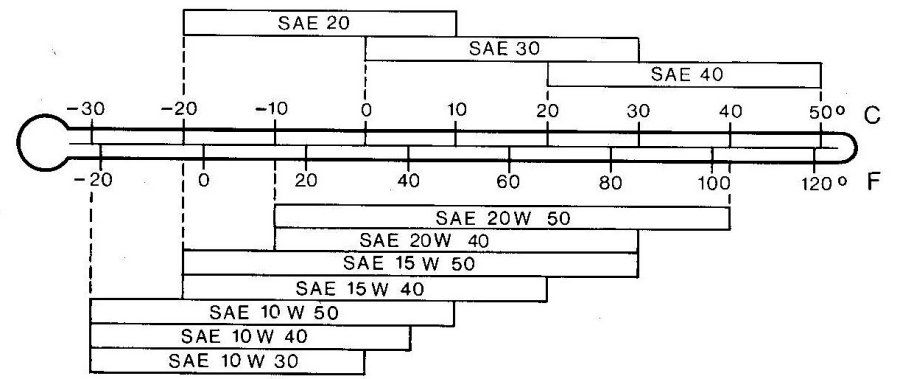
Here is a BMW chart on viscosity ranges and recommendations. This chart is a later version, and pretty good, and was for Airheads: https://bmwmotorcycletech.info/BMW-Oil-Recommendations.jpeg
Be advised that Rotella, Rotella-T, Delo, and Delvac oils, WILL be having much less ZDDP put in them, & this started in a small way in 2007. Some type of slow phasing out or a reduction was mentioned in a number of places; due to some diesel-equipped cars and trucks that are having catalytic converters installed. Diesel oils need more detergents and dispersants in them. HIGH levels of detergents are not necessarily the best for Airhead engines. The latest information I have shows that, at least for Delo, the ZDDP content is still OK. This was in 2011 and 2014 data. My guess is that the reduction in ZDDP will be phased in over a number of years. ASK the manufacturer!
NOTE....this is a 2019 update! DO NOT use Rotella T1 oil, the zinc has been overly reduced, as I expected it eventually would be. Still safe: Chevron Delo 400.
Besides the heat treatment variability of some BMW parts like camshafts, followers, and rocker arms, which influence my recommendations ....ZDDP type additives really come into their own (they do offer some help earlier) at the point that things are getting a bit extreme ...high rpm, hot temperatures, lengthy riding at high power levels ...etc. ZDDP is fairly critical when breaking in a new engine, or even just new rings or cam followers.
Some additives work at very cold temperatures for cold start protection. Most are not too good at this ...and most not good at all if the engine sat for a few months. Many cheaper oils are just not good at keeping an oil film on parts if the engine sits for some time. The proper additives of good quality will help here ...another reason to purchase a quality motorcycle specific oil.
ZDDP protection tends to come into play at cams, lifters/followers/cylinder bores, perhaps piston rings and rocker arms, possibly some other areas. Once there is enough of the compound in the oil, you get no more protection, only more cylinder deposits. 0.15% is probably just fine for full protection. 0.18% is a really good compromise, and the level won't go down too much between oil changes, even somewhat extended changes. 0.2% is beginning to be too much and under .11% too little. I get into this deeply in my https://bmwmotorcycletech.info/oilessay.htm article. I selected Golden Spectro 4 in 20W50 as my primary airhead engine oil DECADES AGO, as it has never shown the slightest problem with cams, followers, etc., and the additives do NOT burn off quickly like it does in cheap oils, and it DOES have many other desirable qualities. Oak liked that oil, I like that oil, every test seems to show it is a truly good oil. I don't intend to get into a lengthy argument on oils. Been there ....done that. I have nothing against you using the full synthetic version of the Spectro oils either ...good stuff! Do change it regularly, don't try to get 12,000+ miles on it; some of the additives will have burned off or converted or otherwise become ineffective ...if there are enough start cycles ...and miles.
I think a reasonable change period for Golden Spectro 4 semi-synthetic is about 4000-8,000 miles, but not over a year (maybe two years if your trips are long enough to fully heat the oil). If doing in-city short trips, lots of stop and go; and especially with an older somewhat worn engine, generally do 3000-4000 mile changes, maybe up to 6000 on a FULL synthetic oil; but not over ~ a year.
You can change the filter every other oil change.
A 20W50 oil is usually a better oil, from the same manufacturer, than their 10W40 or 10W50. The wider the range (divide the second number by the first) the worse the oil will be, long term (as miles accumulate), as the viscosity narrows from use.
You can use wider range semi-synthetics and full synthetics, the 15W50 are generally good.
Castrol GTX in 20W50 is NOT a great oil for Airheads, no matter the hype. I do NOT trust many Castrol engine oils ...since "the lawsuit". It is difficult to find out what the ZDDP level is in many Castrol oils these days, and their 'full or partial synthetic' oils may not have any real synthetics in them (I am not kidding, that was the thing in the lawsuit that an unsophisticated judge ruled on). Castrol's 4T oil, (and Grand Prix oil, which is the same oil) in either grade 10W40 or 20W50, as appropriate to your climate, is SG rated and formulated. Zinc component is 1100ppm; Calcium component is 1900 ppm; and Phosphorus component is 1000 ppm. If you like Castrol oils, or others are hard to find, these two should be OK, if just a bit sketchy on ZDDP content %.
As oil gets miles on it, the bigger molecules are sheared by various engine items, and the oil is no longer the viscosity you had when the oil was fresh. That does NOT mean that you should use single weight oil! This is one of the reasons to not try for 8000-10000 miles on oils unless you are careful about the situation.
Another problem is that ZDDP is actually used up and no longer has the necessary levels in some oils containing it ...after maybe 4000 miles, in some cases even fewer miles. ZDDP originally was invented for corrosion preventing purposes in old plain bearings, and its protection against metal-to-metal contact/wear was later recognized fully.
With reasonable usage, and not too many short trips under 10 miles or so, you can probably change oil at 4000 to 5000 mile intervals, and change the filter every second oil change ... with any quality oil. You can go farther with full synthetics in general, although the ZDTP tends to decrease, perhaps too much of a decrease. I personally have NO problem with going to 6-8000 miles on Golden Spectro 4, which is a PART synthetic oil ...on a long trip ...in which all or nearly all the mileage is in large amounts per average day. This is because the oil works best, and is VASTLY less contaminated by moisture, in this type of riding.
https://motorcycleinfo.calsci.com/Oil.html is a hyperlink to a long article on oils. I disagree with a few things, and a few conclusions, but the vast majority I do agree with. The article has a tremendous amount of information. This is the article I personally like/know of (outside of my own!) dealing with engine oils. There is a lot of stuff on his website, in other articles. He's nerdy, somewhat like meeeee.
Fuel Additives. More on engine oils. Some nerdy technical things. Gasoline's, etc.
There are probably hundreds of additives that one can purchase to doctor-up one's engine oil. Do NOT purchase and use ANY of them regularly ...but, read on:
Some additives for your gasoline are good now and then, for very specific reasons. The use of Standard/Chevron's Techron additive (cheaper and better overall to get it by purchasing their gasoline; I've done the math for you, assuming you start with a modestly decent combustion chamber) is a good idea. Techron additive was a polybutane amine compound. There is a boron component, I think. Originally identified as F310, it was reformulated many times, and in 1980 it became a polyether amine, and so remains today, with minor changes in overall formulations. For modestly coked up combustion chamber/heads, use of bottled Techron as found at your auto-parts store, and following the container instructions, gives a mixture that is about ten times the strength of the Techron in Chevron Gasoline's at the pump. You can use the bottled stuff a couple times a year, and it will keep your combustion chambers cleaner, and it does help clean them if already carbone'd up. Use of the Techron containing pump gasoline will help keep your combustion chamber cleaner. Once cleaned, it is probably cheaper to purchase the Techron, for overall effect, at the pump, it is already in the gasoline. The bottled formula is not just concentrated, but is a slightly different overall formulation, designed to work faster. As a bit more background, California was the leader in the U.S. to require various formulations of gasoline's to reduce smog. The California Air Resources Board (CARB) requires deposit control additives, this was set in stone in 1992, and modified in June of 1999 for even more additive levels. Intake valve deposits are under a certified testing routine for all gasoline, ASTM-D-5500. I believe that Techron works better than other additives, and the bottled additive, used to help clean already coked engines, contains light aromatic naptha, stoddard solvent, benzene's, xylene, cumene,... all are besides the main working ingredient. So-called "Tier-1" gasoline's are better. Do a Google search and read up on them. You may be surprised that quite a few discount brands of fuel are Tier-1. COSTCO sells top Tier 1 fuel.
Most other additives, that you purchase and add to your tank, are hyped. People do not want to face up to the fact that they are influenced by advertising. People want to feel like they are effective in life, have done something good, have an inner need. Don't bother with most additives that you would separately add. They are a waste of money, and in some instances can do damage to an Airhead. Techron for gasoline is an exception. If you don't add Techron now and then, buy their fuel; or, purchase, regularly, some other Tier-1 fuel.
BMW camshafts and followers are very conservatively designed and built, with long life, quietness of action, etc., as goals. The cam lobes are mild in rate of lift rise. Still, heat treatment appears variable, and that is why I recommend NOT using cheap, or even expensive, "car" oils. Besides this, BMW cam and followers are mechanically manufactured in an old style ...such that a good oil film with a good dose of ZDDP is a practical necessity.
Some oils are poor if the engine is run infrequently. Some oils will not hold up to the very hot temperatures in the Airhead valve areas. Just because the crankcase oil measures 225�F perhaps, does not mean the oil is that temperature at the valve guides. Some oils will drip off parts until the parts rust. In particular, these things are traits of single weight motor oils. There have been instances of moderately frozen-up Airhead engines from sitting with car oils in them.
Oil changes need to be done more often in high power high temperature riding and if riding many short trips, say under 10 or 20 miles. Filters generally are OK for two, sometimes three, oil changes ...perhaps even up to 9000 miles, or more, in a reasonable length of time. That does not mean I approve of 9000-12000 miles between filter changes, except under very specific situations.
For severe cold or extreme hot weather use, a synthetic like Mobil 1 with lots of ZDDP may be best, in their V-Twin version which has increased additives. There are better synthetic oils, at a higher price.
I am, as is the guy who wrote the website (see link well above), very suspicious of some magazine reports on oils testing. They do not test for actual long term engine wear; nor usually for usage (some cheaper oils are burned off much faster, particularly initially). Reports from a lab on metals wear as seen when analyzing oils, is NOT enough information.
I don't trust all 100% synthetics for maintaining seals size and condition. Golden Spectro4 20W50, a PART synthetic, which I trust, having years of experience with it, including engine teardowns, is very good.
Full synthetics with lots of ZDDP seem to be the better choice for truly severe conditions. Some of the better full synthetics are quite good these days at all temperatures and conditions; so I have reduced my previous cautions about them.
Some manufacturer's change formulations without telling anyone. This is quite common. Castrol GTX changed. Castrol won a lawsuit, dealing in what the word 'synthetic' really means. Be careful of Castrol engine oils ...except, so far, 4T and Grand Prix (at least, they seem to be OK, but not superior).
For touring with longer mileage between engine starts and stops, in mild to moderate conditions, 5000 miles between oil changes can be reasonable. On one long trip, over some weeks, I would not object to even a longer drain interval, if using a quality oil. With a full synthetic or quality part-synthetic, and long trips, longer drain intervals are probably OK. Just do not go overboard here ...remember, you want the ZDDP and other oil additives to remain in your oil, providing protection.
Slick 50 was an old product containing a version of Teflon, ....and, IMO, was potentially dangerous to your engine's health. The company is still in business, with new formulations. Slick50 caused some flat boxer type small aircraft engines to fail. It is true that some types of additives will give less friction, and maybe a small bit of higher fuel mileage. That does not mean less wear. Some additive products will clump out, plugging oil passageways, this usually happens at sharper bends in the oiling system, where the flow gets modified, due to the sharp bend. Especially worrisome are additives containing Teflon or similar. The maker of Teflon, DuPont, has cautioned about wrong use of its products for decades. My advice is to not use Slick50, nor, any similar or even any additive to the oil ...but, see the next paragraph.
Bardahl, Rislone, Marvel Mystery Oil, etc. ...are not usually used in Airheads. In rare instances, these, including CD2 engine cleaning detergent additive, are used for cleaning. This is particularly so on Classic K bikes, with their notorious starter sprag clutch, where Rislone or CD2 can possibly be of help, used once. VERY HIGH detergent levels are NOT good for your Airhead engine. There is an article on this website about using these products in a classic K bike: https://bmwmotorcycletech.info/kstartersprag.htm
I have gotten into the technical area of oils to great depth. Jigs, test engines, additive types, temperature effects on residues, neutralization number, channeling, shear strength, film strength, foaming, detergency, oxidation, etc. The only area I could never get good (IMO) agreement on, with engineers, is seal compatibilities ...due to all the variables.
Ashland Oil Company makes Valvoline brand products. Valvoline 4-stroke motorcycle oil in 10W40 (for colder climates) or 20W50 for moderate to rather warm/hot climates, is still a good oil for Airheads. The zinc content of these two oils is 0.112%, phosphorus is 0.103%, calcium is 0.182%, and sodium is 0.052%.
For Shell Rotella-T, in 15W40, the calcium is ...or was ....0.27%; zinc is 0.135%, and phosphorus is 0.120%. A GOOD oil, and many use this oil in their Airhead motorcycle. NOTE....this is a 2019 update! DO NOT use Rotella T1 oil, the zinc has been overly reduced, as I expected it eventually would be. Still safe: Chevron Delo 400.
Do not use single grade oils in your BMW airhead unless you have a very good reason ...such as being someplace in the world you cannot find a proper multigrade oil. In almost every respect, modern multigrade MOTORCYCLE oils are vastly better than single grade oils, especially in non-car viscosity grades.
Most engine wear is in the first minute or so of cold startup. Think about that, ponder upon what it can mean. THINK!....and, perhaps think again, about what blipping the throttle to too high an rpm during initial startup might mean to the reduced clearances in your cold engine.
Changing the oil regularly is the most important thing. That does not necessarily mean every 1000 miles (unless you put on 100 miles a month) ...and it might be 5000 or longer. Depends on conditions and usage.
DO NOT run your engine every month or so for a few minutes in your garage during Winter storage. This will result in moisture condensation in the oil, and perhaps sulfur-based acid buildup; better to not run it at all, and, don't rotate the engine.
SE oils were LONG AGO specified by BMW. SE oils were not, however, held to tight enough tolerances by manufacturer's ...there were real abuses, and SF replaced SE, and is obsolete. BMW Airhead engines need a good quality genuine SG oil.
'Viscosity index' is a number that indicates the RATE of change of the thickness of the oil, within a given temperature range. A HIGH index number means the oil thickness (viscosity) varies LESS with temperature changes. ENGINE oils are specified, generally, at 210�F (98.9�C), except that engine oils with a "W" (Winter) are specified at 0�F (-17.8�C). This means that a 20W50 oil is specified at TWO temperatures; for 20W at 0�F, and for 50 viscosity at 210�F. For the nerdy, SAE ratings are measured or specified in centipoises at 0�F and centistokes at 210�F ...and, let us not get into Saybolt Universal! If you are interested, look up these things.
What 20W50 is SUPPOSED to mean, and generally DOES mean, is that at 0�F, a very wintery temperature, that oil should be the same thickness (viscosity) as a UNcompounded (single weight) oil (that would be called SAE 20) is at that same cold temperature. The "50" means that at 210�F, that oil should be as thick as a SAE 50, at that temperature. Think about this paragraph for a minute. If you DO think about what I said, you will understand that even a 20W50 oil can be rather thick at cold temperatures and not great at flowing through your engine until the engine warms up. You will also understand that 20W50 is considerably better than a NON-multigrade oil for our engines. You might even be thinking of just HOW the oil manufacturer managed to make a 20W50 (or 15W50, or 10W40, or 0W30, etc.) oil; and, then, perhaps think about whether or not the multigrade (or a single grade) oil will, or will not, remain in the viscosity grade for which it is being sold.
Cx oils (replace the x with the latest letter) have specifications for sulfur content, and for temperature for release of various activity of additives, etc. Cx oil rating is concerned with many factors, some of which are pertinent to Airhead engines, some are not. A problem with Cx oils is that most of the active agents for protection of metal to metal contact are for vastly higher temperatures and some pretty extreme pressures (after all, they ARE diesel engines) than in Airheads. Thermal stability and breakdown point of additives are different. It was fairly critical, many years ago, that Cc oils NOT be used in diesels that needed Cd oil. We had oils, most are like this today, that are rated for gasoline engines and diesel engines, and you may see the oil container marked for Sx and Cx use. These crossover oils, when sold for cars, tend to not favor the high temperatures of the turbocharged diesels, and the additives, or some of them, do not work well at gasoline engine temperatures and other conditions. Just to complicate matters even more, there is a TREND since ~year 2010 ... towards cars having smaller displacement engines, direct cylinder injection fuel systems, and even turbocharging, .....yet even having high compression ratios, some have VERY high compression ratios, nearing 14:1. The result are sometimes oil wash-down on cylinder walls, deposits in the upper piston groove/lands and heads, ....and pre-ignition and thus exploded engine problems. Specially compounded engine oils are being used to help with such problems. These oils should NEVER be used in your Airhead motorcycle!
BTW....Sx oil means spark ignition engine; Cx oil means compression ignition engine.
Sx oils have changed VERY considerably over the years, and the additives and compounding is quite different from earlier oils. Many characteristics are for increasing fuel mileage and decreasing damage to catalytic converters, and in some instances to help with decreased clearances and other lubrication and deposits problems, see prior paragraph, in very modern engines. All sorts of considerations are made, antioxidants, pour point depressants, anti-foaming, anti-scuff, detergency, slipperiness, etc.
There ARE just-for-diesel-engine oils that are now OK for gasoline engines, such as Rotella, Delo and Delvac. These oils have had quite adequate amounts of ZDDP, which car oils after SG did not. Rotella-T has been a popular oil for Airheads, for good reasons.
But, the new T-1?...well....NOTE....this is a 2019 update! DO NOT use Rotella T1 oil, the zinc has been overly reduced, as I expected it eventually would be. Still safe: Chevron Delo 400.
MOTORCYCLE oils in 20W50; 15W50 and 10W40 do not have to eliminate ZDDP, ...those grades are exempt from the SAE and API requirements, and thus they can be real SG oils ...and can state on the container that they meet the quality (not specifications) of SL ...or anything else. Yes, it all was certainly confusing. I hope my explanations in this article have informed you.
Friction considerations:
Friction is a difficult topic, with regards to what it truly means with regards to engines, transmissions, etc. Oil separates potentially rubbing surfaces by very complex means. Read: https://bmwmotorcycletech.info/oilessay.htm. Thick oils have more internal friction, but can support heavier loads, but that is a complex thing to understand, and surface speed is involved too, but is covered in that oil essay article. An ideal oil would not change viscosity appreciably with temperature change for friction purposes. High pressure alone increases viscosity of an oil; this seems wrong, but is true; and this is why a thin oil can support heavy loads, like in the connecting rod bearings. A thin oil is far better for cold startup. Because of these things, use of thick oils is not a good idea in BMW Airhead engines. It is just one reason, of many (including generally being poorer at sticking to surfaces during storage), that single-weight oils are not a good idea, at least nowadays, when multigrade oil performance is vastly better than 50+ years ago. I can see almost no use for single grade oils, except maybe for first 50 miles of break-in; or, where you cannot find good multigrade oils.
If quality multigrade oil was not available, for example in Latin America or in the very hot deserts of the Middle East, a single grade, perhaps 40 wt., would be OK.
RPM of moving parts influences the heat developed, and high speeds of those parts means faster shearing of the oil itself; but, conversely, high rpm helps form a cushion in bearings, so higher rotational speeds generally allow higher loading. That is why lugging your engine by using lots of throttle at low rpm is not a good idea; and there are other reasons, such as at the piston and rings. In conrod bearings, main bearings, and others, this "cushion" that is formed by high rpm, varies greatly with the size of the round moving part, because one of the prime factors is the surface speed of the parts. In one way of thinking about this, let's say the crankshaft is being discussed, the oil gets injected into the bearing area by a hole in, lets say, the conrod journal. As the crankshaft rotates, whether or not it is a rod moving some, or a stationary surface in contact with the crankshaft journal area, as in a main bearing, the moving part, once surface speed and other conditions are met, piles-up a wave of oil. This oil layer, and the wave too, can be unbelievably thin. With the proper design, the rod is well-separated from the crankshaft journal, yet can handle enormous pressures from the piston pushing down on the rod, or the crankshaft journal pushing up on the rod. There are very common designs, even having nothing to do with engines, that have a microscopic oil layer, some have a molecular level thickness......just enough so that the moving part can start-up and move AIR, to create that "cushion"; yes, air bearings. How else do you think something like the bearings in a computer hard disk can run for so many years without problems?
AIRHEADS: After the oil warms up, and you are at idle rpm, there is, depending on engine wear, etc., very little oil or even no oil, coming out of the pressure relief valve area, to lubricate the chain and sprockets. This is why lengthy idling ...and especially too low an idle rpm ...is a BAD idea. This is in addition to the bearings in the engine not having enough pressure with lengthy idling, to support the oil film at low rpm ...especially on a well-worn engine.
Gear Oils; transmission, driveshaft, rear drive. GL4? GL5?:
Gear oils are specified for different temperature ranges, and their additives are most active in those temperature ranges. This is particularly so with the W rated gear oils. An 80 weight gear oil is not as thick as an 80 weight engine oil would be at the same temperature (assuming you could even find an 80 SAE engine oil). The measurements, and grades, are very different.
I suspect that Airhead rear drives may not like the new wider range hypoid oils that are available, such as 75W140, but have no proof, and yet I think those oils might be better in our Airheads for extreme situations, such as pulling a trailer or sidecar, or VERY hot weather at speed. I may have more to say on this in the future ...probably in my essay article on oils. Until then, my recommendation is to not use them.
I generally use 80W90 GL5 petroleum oil at the transmission (and driveshaft on models requiring oil in the driveshaft) and rear drive. Petroleum oil and synthetics are available as 75W90 which are OK, but some full synthetics are not 'sticking' to metal surfaces all that well after some storage time, and because of that, and some other characteristics, I am generally recommending one use a premium GL5 petroleum gear oil. There is some controversy about using synthetic oils in the transmission. I am in the middle of the arguments. More on this further down this article.
There are also much wider viscosity oils available, such as 75W140; 75W145; 80W140 and 85W140, etc. These extra wide range types in GL5 type are OK under certain quite severe circumstances, although I have vry mixed feelings about them. You might consider using these wider range gear oils if you live in the very hottest climates and travel fast, or pull a trailer or sidecar at highway speeds; all these types of things being done most of the time. Otherwise, I can not recommend the use of such wide viscosity ranges. Use of extra wide ranges like these can result in strange happenings in both transmission and rear drive and driveshaft. Poorer lubrication in the driveshaft area. Improper spin-down of the gears and meshing speeds in the transmission meaning weird shifting ...and poorer lubrication. There may be cold overflowing or poorer lubrication in the rear drive.
The GL4 ... GL5 'controversy'; the REAL information:
NOTE: Some folks still say/promote/publish/etc ...that for certain transmissions and rear drives, that have 'bright metal' (brass, bronze....) parts, one should not use GL5 gear oil. Gear oils vary, most GL5 oil's are acceptable for BMW use. To be sure, use a specially treated GL5, such as Spectro's. It is not critical for any of the common GL5 oils I have tested. A very quick summary is that in the AIRHEADS, there is ONE BRONZE spacer/shim in the rear drives, and BMW SAYS TO USE GL5. That covers it, EH?....well, it doesn't, due to how I opened this paragraph "Some folks...". I will explain what to do, and, what is going on.
Disregard information you may have heard about sulfurs in GL5 being bad on Airhead rear drive brass or bronze parts. IT IS NOT TRUE. The bad information is a hold-over from pre-Airhead days; and, even then, only with certain early bikes. Here is the information, in case you want it. This is where BMW advised about the changeover on early BMW bikes from engine oil being used (yes, that was commonly done) ...or early versions of gear oil (usually we say GL4) to GL5 hypoid rated oil. From Barrington Motor Works; Chris Betjemann's BMW/2 Motorcycle Restoration and Service Manual (A Guide for the BMW /2 Owner/Restorer). Confirmed.
BMW AG, recommended lubricant changeover oil to hypoid.
(By Model and Serial number/engine/frame No.:)
(NOTE that these are NOT Airheads)
|
R50 |
R60 |
R69 |
|
|
Trans |
646358 |
1814032 |
663565 |
|
Boot |
646486 |
1814032 |
663565 |
|
Shaft |
646486 |
1814032 |
663565 |
|
Final Drive |
641986 |
1814032 |
661445 |
AIRHEADS: There is one bronze shim, not brass, in the rear drives in the Airheads. BMW specified a GL5 gear oil. BMW knew that is correct, & I agree. Use GL5. NOT GL4! ....in all Airheads. A fuller explanation about GL4, GL5, etc, is here:
https://bmwmotorcycletech.info/viscosity.htm
I have changed my recommendations on using only a dino oil in transmissions. My present recommendation is that if YOU decide to use a synthetic gear oil, it should be of very high quality. For synthetic gear oil I am presently saying ONLY "OK", and only the Spectro brand, in 75W90, in the type called "Platinum". It can be used in the transmission and the rear drive of Airheads and Classic K bikes. It is OK for the driveshaft. It is my belief that it can extend transmission time before overhaul by a considerable amount. At least one rebuilder strongly disagrees with me, and seems to think that synthetic gear oils decrease reliability; I am not at all convinced, and so far he offers no definitive proof, nor definitive technical information. Neither have I. However, there does seem to be SOME evidence that some full-synthetic oils can cause problems in the transmission, from insufficient oiling at some areas, which causes friction INcreases, and excessive wear. I am not sure about that for the rear drive. There is SOME evidence that the gears in the transmission, possibly rear drive, will shear some of the molecules, of some of the ingredients in synthetic oils, differently than with petroleum or part-synthetic oils, and the result might be excessive wear.
There is a LOT of evidence that quite a few full-synthetic oils will cause previously not leaking seals to beginning weeping, then leaking.....this is known for the engine, transmission, and rear drive. Typically the leaking is reversible upon a change back to petroleum oil, but it takes time. Frankly, I think it, over-all, safer to not use full synthetic oils in Airheads.
See further comments here, on this subject: https://bmwmotorcycletech.info/viscosity.htm
DO NOT use any additive with synthetic oil in the transmission, such as the Dow Corning moly type additive. In some instances, an additive is warranted to "try" to improve poor shifting or noise. Be very cautious. Keep in mind that poor shifting can come from several things, including improperly adjusted clutches and lack of fresh-enough lubrication on the transmission input splines. For a transmission oil additive, use considerably less than the containers call for. About 2% (not over 3%) of Dow Corning M Gear oil additive (do not use it with synthetic oils), or Guard Dog GD401 for petroleum oils; and same amount of Guard Dog GD421 for synthetic oils (Guard Dog is out of business). For the Dow product, very thoroughly shake the container so the contents are well-mixed, and use ONLY the concentration I recommend ...and absolutely not the 5-10% Dow suggests on the container. If you decide to use this additive, 18 to 20 cc is about correct for your transmission (~800 cc total oil). If you have problems shifting, and YOU wish to try it for a thousand miles or so, to see if it helps, it is not MY recommendation. If no help (likely, except maybe for smoother shifting), you have other problems. Do check the clutch adjustments. It is possible that this additive may increase the lifetime for the bearings, etc. IFFY. DO NOT use the Dow M product with synthetic oils, and DO NOT increase the dose! For the rear drive, you can use about 2%.
Fork oils:
BMW fork oil, the old original red fork oil, was, at least in the USA, a USA military-specified hydraulic oil; the mil-spec was MIL-5606. Due to how it is specified, and the lack of superior stiction fighters and some other characteristics, you are much better off with a real fork oil ...especially a full synthetic.
MIL-H-5606 (with any letter following, such as E or D:
MINimum 4.9 Cst at 100� C
MINimum 13.2 Cst at 40� C
Maximum 600 Cst at -40� C
Today's quality fork oils are better, especially for viscosity index and anti-foaming (nice to have those forks handle the same after a few miles of bumpy road) and improved anti-stiction qualities (nice to have the forks, if properly aligned, to react to small bumps and road irregularities). BMW has designed the various front fork hole sizes, valves, clearances, etc., for use with a rather thin oil, roughly SAE 4. In another measuring system, it would be about a SAE 7. Use of oils of 7.5 is fairly common, but over 10 usually means something is wrong (except on the R100GS, etc., with 10 in one fork, 15 in the other, per spec). Some oils that are OK for use in BMW forks may be marked as Suspension Fluid ... or ...fork oil. The proper viscosity for the fork oil in all but the R80R, R100R, R80GS, R100GS, is SAE 4 ...but to be more exact, the viscosity should be 13.2+- at 40�C (104�F). You need to know the viscosity at that temperature, and can mostly forget the other temperatures that are often quoted. One manufacturer's SAE 5, or any other fork oil, is not the same as another's ...so see their specification sheets. When trying different fork oils, I suggest you use the same manufacturer. I have an article, https://bmwmotorcycletech.info/viscosity.htm, that gets rather deeply into fork oils (and some on engine oils), naming the brands, models, true viscosities, etc.
I like Spectro's fork oils & suspension fluids. They are good, have low stiction, wide temperature range (decent VI too), & the viscosities can be depended upon. There are other quality fork and suspension oils available.
For the fork and suspension oils, the various manufacturer's do not agree very well on measuring, well, stating, their viscosity. Because of that, stick with one manufacturer if playing with viscosity grades. Except for some GS models, all the old BMW's needed a very thin oil, roughly SAE 4 or 5. For the most part, you can translate that to modern 4 to 7-1/2 fork oils. A formula to convert Cst to SUS is in the viscosity article, link just below. Heed my remarks about sticking with one manufacturer. On this website is an article on oil viscosities, and other characteristics, by brand, etc. Lots of information on shock and suspension fluids/oils and some on engine and gear oils too. https://bmwmotorcycletech.info/viscosity.htm
Some full synthetics may not be compatible with rubber parts in some BMW forks.
|
Oil change intervals, engine, gearboxes and forks ....in brief. |
| Motorcycle-rated petroleum multigrade oils: engine oil change at 3000-5000 miles for mixed riding (short trips, long trips, mixed weather). |
| Motorcycle-rated semi-synthetic multigrade oils: engine oil change at 4000-6000 miles, with same conditions as above; up to 7,000 with longer trips & fewer stop and go miles, in one year or less total. |
| Motorcycle-rated full synthetic multigrade oils: engine oil change at 6000-7000 miles. Not too many short trips. Primarily trips over 40 miles. Mixed weather. 1-1/2 years or less total. |
| Gear oils: 10,000 miles for quality dino oils and semi-synthetics. |
| Gear oils: 15,000-20,000 miles for full synthetics. |
|
Fork oils: non-racing conditions. Quality oils, 15,000 miles. |
Revisions:
01/16/2008: Revised to include latest information on oils, and to clarify details on canisters, etc.
01/22/2008: Updated for clarity only.
07/12/2008: Revised item 2, add more information on oils. Oak's comments added. Entire article edited a bit.
07/14/2008: Revise the article in line with latest reports on diesel oils.
04/13/2010: Slight updating, adding some oil characteristics content; + adding a hyperlink to my viscosity article.
04/24/2010: Go through entire article and fix typos, and bring up-to-date. A tad more on 11/12/2010.
11/18/2010: Add Castrol 4T zinc amount.
02/24/2011: Was 52B.
10/11/2012: Add QR code; add language button; update Google Ad-Sense code; minor other editing.
11/05/2013: Edit article for better clarity.
03/03/2014: Correct the information reference from 51A, 51B, 51C, 51D, to 52x. clarify some details. More on 03/12/2014.
05/01/2015: Updated, and a few clarifications on 09/01/2015.
03/10/2016: Update formating and metacodes, plus a few slight clarifications.
09/22/2016: Update metacodes, scripts, add tables, clean-up.
05/31/2017: Clean up fonts, colors.
08/14/2017: Minor clarifications. Add section on clarifying outer covers and refilling oil coolers. Reduce some colors, fonts, bolds, etc., in favor of underlines, etc.
03/04/2018: Clarify explanations. Change layout placement of various sections to avoid confusion. Add 10pxl margins.
07/23/2018: Add more to section on oil amounts for gearbox, rear drive, driveshaft, improve clarity.
08/19/2019: Add caution on Rotella T1.
05/05/2021: Clarifications, and some data changed.
08/02/2021: Clarification on refilling the canister, assuming new filter prior to engine start.
� Copyright 2021, R. Fleischer
Return to Technical Articles LIST Page
Last check/edit: Friday, October 22, 2021