
|
|
The ads above are Google-sponsored.
Clicking on them at every visit helps support this website!
Clicking on something inside an advertisement helps even more!!
THANKS....and thanks for the donations!
Starter Sprag Clutch problems in Classic K bikes.
The Classic K bikes are the "flying bricks" ....
models K1, K75, K100, K1100, and K1200, all versions.
https://bmwmotorcycletech.info/kstartersprag.htm
K1
� Copyright 2020, R. Fleischer
REFERENCES:
A description of starting problems, starter sprag clutch, various fixes, photos, etc., are an article entitled "Starter Clutches In K Series Bikes", published in BMW Owners News, authored by Paul Glaves, in the December 2004 issue. I recommend you obtain a copy of that article. Paul's article, as well as mine, below, lists some possible easy fixes, such as oil additives, etc. My article, below, does not cover a few things in Paul's article.
INTRODUCTION:
You will be quite unhappy if the starter sprag clutch fails. The labor just to get to it is a very large amount. The entire rear end of the bike must be removed, including wheel, driveshaft, rear drive (and Paralever if you have that), alternator, transmission, clutch, secondary gear case, etc.
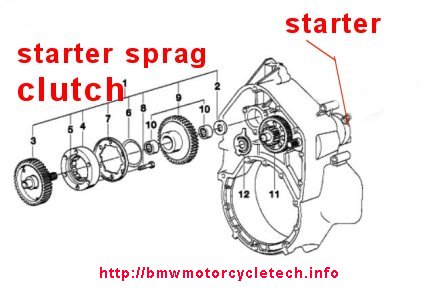
The one-direction sprag clutch is driven by an intermediate gear associated with the starter motor. See the sketch below the photos. The sprag clutch, intermediate gear, and more is located in a secondary gear case, rear of the engine crankshaft.
The three photos below are from one of my "analyze things for the Club" projects. This particular starter sprag clutch is of the later updated type having additional sprags. The earliest K100 bikes had fewer sprags ...the updated assembly turned out to be some of the answer to problems, but not entirely.
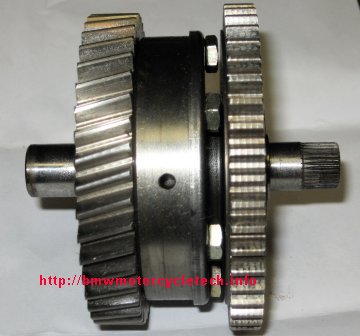
In the photo below, the red arrow points to a 'sprag'. The sprags are all individually sprung, and they can rotate slightly. Further explanation is below.
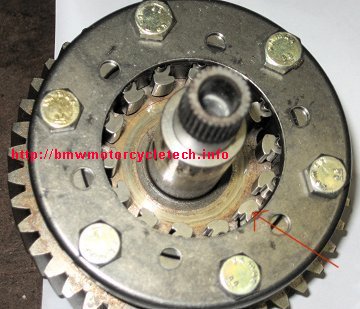
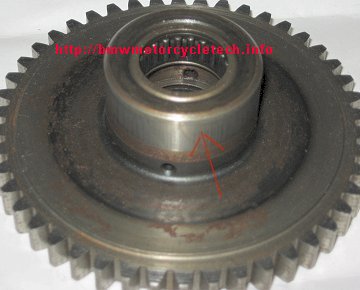
In the photo below, the red arrow points to the surface the sprags are associated with. The sprags are always very lightly in contact with that surface on the gear part, below, when the engine is at rest, or, engine is running. When the engine is running, the direction of the part, below, is not that which will cause the sprags to greatly increase their friction to the boss. The sprags are freewheeling; ..or, think of it as just not transmitting power; that is, only a very light pressure, via an oil film, is had in the freewheeling mode. A fair amount of oil flows over and through the parts. When the starter motor is powered, the starter rotates the intermediate gear, which rotates the below part. The direction of rotation causes the part in the above photo, and the part in the below photo, to 'lock-up', which means they will rotate as one entire assembly. From this, the engine is made to rotate during starter motor operation. When the starter motor is not being energized, the assembly free-wheels.
Below is an annotated copy of the sketch from BMW's fiche for a K100. To eliminate confusion, I have removed the alternator from the sketch. Here is a different way of describing how it works:
The starter clutch is a constantly running device that is designed to transmit force in one direction, and it is not supposed to have any appreciable grabbing engagement until the starter rotates, which is supposed to cause the sprags to move the other direction, and that movement should LOCK-UP that clutch, so the starter rotates the engine. When the starter is NOT powered, the starter sprag clutch is free-wheeling, with no appreciable friction (one hopes) in its innards. The starter sprag clutch is a ONE-WAY power transmitting device. One direction, it locks up, other direction it rotates freely, with no coupling between the two main parts other than quite minor friction of sprags against the oil film contact involved.
What are the symptoms and simplest 'fix' for a starter sprag clutch acting up? What is one of the first things to do at signs of any acting-up? What can you do to try to help keep such problems from happening?
If the starter rotates (very audible) but the engine does not turn over, or poorly:
You might (or might not) have screeching noises. Starting may be intermittent. Often you can start the engine by push-starting, pushing the starter button as you let out the clutch, to start the fuel pump. The situation may vary with temperature conditions. Sometimes one can temporarily 'fix' the problem by having the bike in gear and trying to move the engine counter to normal rotation direction by moving the bike backwards a small amount. It is possible for a combined problem, with the starter motor having a slightly dead spot it stopped at the last time you used it.
If problems are just beginning, I suggest you drain the oil and remove and replace the oil filter. Install fresh FULL SYNTHETIC oil. The oil that has the best reputation for no or least sprag problems is 15W50 Mobil 1.
If things are more than just beginning, you need to be more aggressive :
A possible fix, temporary or?: Put some Rislone or CD2 Engine Oil Detergent into the oil. You need NOT change to fresh oil for this process. In fact, it is my belief that this works best on dino oils, but certainly works on part synthetics and synthetics too. These are solvent-detergent cleaners. Rock the bike, in gear, backwards if you have to, to enable engine starting, or push start it. After putting quite some miles on the bike, perhaps a couple of tanks of fuel, drain the oil, replace the oil filter and install fresh oil, full-synthetic. 15W50 Mobil 1 is recommended by me. If the Rislone or CD2 treatment does not work, you will have to do a lot of work to remove the starter sprag clutch and replace it (DO NOT try to just clean it). Because of the labor involved, many will think about waiting until they need other major work, such as a clutch overhaul.
HINT: Push starting is part science, part art. Use 2nd or 3rd gear, and do not use the clutch as an instantaneous release of the lever, but not too slow either. You want the engine to rotate, but not way too jerkily intense, and at the same time you don't want the rear tire skidding (which will usually happen if you use first gear).
WHAT fails with the starter clutch?:
They get some sort of hard-to-see deposits, sort of clear coating ....and there may be sprag wear. These things are not conducive to the sprags locking into the starter functioning position. The sprags themselves will also wear out by changing shape. The shape is CRITICAL. The springs may be gunked-up too, see next paragraph. If you have the early fewer sprags version, REPLACE IT with an updated parts assembly.
Suppose you have done the large amount of labor to get the sprag clutch onto your workbench and you see mechanical damage.
Sprags not spragging? Look at them carefully. You may see a "polished" flat where it runs on the inner cylinder lightly pressed there by the springs. When the springs get quite dirty, they end up exerting less force and so less friction for a sprag to "lift itself" over the high point to start wedging. You can feel the one way action with your hands. You can try a bit of force. If you can super-clean the springs, sprags, etc., and possibly the sprag clutch assembly is then working again, you can reinstall it, but no guarantees by me. Be sure to read the last paragraphs of this article.At the time of the Aug. 2016 update to this article, I had seen TWO of these sprag clutches (of the later types...not the earliest K bike ones before the factory updated ones) that have failed, withOUT any apparent excessove wear on any part. I had, still do, ONE of these in my shop for a deep study, eventually. Photos of it are above in this article. I was so curious about it, that I paid the owner to send it to me. I have compared it to a brand-new one, with no good conclusions, beyond the fact that dimensions have not changed much. My suspicions are still that it failed due to unseen-by-the-eyeball microscopic surface glaze, or other type of surface change... on the inner friction 'drum' part (and likely also the sprag parts that contact it). There IS wear, but it 'seems' small. It MIGHT, and probably is, enough to cause problems. The owner told me he had tried both Seafoam and CD-? additives. The owner did not try Rislone. I am not sure of exactly how the owner used the additives. I have cleaned the starter sprag clutch, it seems to manually work fine, but I have not installed it into a K bike for full testing. I may never, as I have closed my BMW repair shop.
No one that uses Mobil 1 (a true full synthetic), has had a problem that has been reported to me. It is entirely possible that OIL is the major problems factor .....or not. I do not want to imply that wear is not a concern. I have seen worn starter sprag clutches; and the springs, if gunked-up enough, could cause reduced tension. Synthetic oils do not tend to leave gunk. My suspicion is that it was also the oil that enabled excessive wear, when that is seen, but I cannot be 100% sure about it. The only way I can get a handle on that, is maybe to actually be present at some teardowns, and MEASURE side-play, and so on. I am a bit hesitant to state that it could be a problem, because there is no indication of side-play wear on the needle bearings in the starter sprag clutch here ...that I can see ...nor on the ones I have looked at in that particular regard (two of them). Keep in mind that a starter sprag clutch works by friction, and it is not supposed to be friction of metal to metal, but friction using an oil film between the parts. Most do not understand how oil films work. There is an in-depth article on this website for anyone who wants details.
I think there is sometimes, or often, more than just one thing at work with the starter clutch problems. I suspect basic failure modes; oil film failure where the result is mechanical damage; or, failure due to a glaze or gunked springs. I am beginning to think that all the other failures, which manifest themselves as wear failures, are due to a combination of oil, perhaps side forces, and maybe there is some sort of production tolerance ...and maybe contaminant/protectant problems also at work.
I am aware that many have never have had a problem with the later starter sprag clutches, and many have used fairly conventional oils. My mind jumps to the same situation with camshaft and followers, in the Airheads. Many got HUGE mileages without problems; others, even running the same oils, had problems. I have personally witnessed these engines apart. What was the answer? Seemed to be heat treatment variations. For the Classic K bikes, I think we have a combination of effects, and anecdotal evidence tends to point towards recommending the use of a REAL synthetic oil (Castrol Syntec is NOT!), like the Mobil 1 that I recommend. It may well be that the higher amounts of ZDDP in Mobil 1 is helping with the WEAR failure modes. In addition, in what APPEARS to be the case, Mobil 1's formula does not leave the surfaces such that the sprags do not properly grab, nor leave deposits in the springs. For those who think that ZDDP may be involved, Mobil does have a V-Twin oil which is their full synthetic with additional ZDDP. See paragraph below.
Until someone does a serious laboratory analysis, right down to the surface's molecular analysis, I doubt we will know much more. Because of the huge amount of labor involved ...not to mention the $$$ parts cost ...I personally use ONLY Mobil 1 in my K bike. The majority of information I have points towards it being much less involved with problems. I have nothing against someone using Mobil 1 20W50 oil, called V-twin oil, that has even higher amounts of certain additives. The 20W50 is a bit better if someone rides mostly in the hot Southwest, etc., where temperatures can exceed 100�F relatively often; and, more particularly if large amounts of rpm and throttle are often used, perhaps a big load, such as a sidecar, etc.
I leave the Mobil 1 15W50 in my K1100LT for the entire year; unless I have put more than 8,000 miles on the bike. A FULL synthetic, like this oil, really does not need to be changed often, particularly if one does NOT do a lot of very short commutes particularly in quite cold weather. My K11 works hard; so is hard on oil ...it hauls a big sidecar. I do change the filter at the same time, sometimes every other oil change. Note that it is the oil's ADDITIVES that wear out (they evaporate, get used-up, etc.), and that is the prime reason to change the oil. An in-depth analysis by a laboratory showed that the additives in Mobil 1 hold up quite well over time and mileage. You get, sometimes, what you pay for. I also use only BMW filters. I have no problem with folks using aftermarket filters, but I find them highly variable internally in quality and performance, so I don't use them.
K bikes seem to use a fair amount less oil if the oil is of premium quality and use less oil if the oil level is not maintained all the way to the top of the sight glass. I like the middle. I use higher levels, just almost reaching the top of the sight glass only if on a long tour.
There are other synthetic oils that likely do a good job; particularly the Golden 4 type from Spectro Oils .....and Spectro does make a full-synthetic version. If the Mobil 1 becomes hard-to-find, I may switch to the Spectro.
My ideas about a very intense cleaning of the springs, and sprags, ETC., and a hand or increased forces test for one way action, possibly working well, and thereby reusing a previously slipping sprag clutch, are not just my own ideas. Well after I had been promoting the cleaning (with caveats!), I began getting a report now and then of folks having good luck with the process. One report in particular, by a trusted source ....told me that a number of times after removing a starter sprag clutch that has failed or gotten intermittent, but exhibited no signs of bad mechanical wear, it could be repaired by a very thorough cleaning in strong solvents. I have, myself, done this to TWO, and I also used ~2000 grit paper in 'de-glazing/polishing' the contacting surfaces; with no further problems from the starter operation; so it was nice to hear that someone had used just solvents to effect cures. I would recommend the polishing by super-fine grit paper, as I did, plus very thorough solvent cleaning (and scrubbing by turkish toweling with the solvents). I used a 50-50 mixture of MEK and Acetone. There is so much labor involved, that replacement may be your choice, since the above might not work. It probably would tend to work, well, more likely, if the chemical detergent additive worked reasonably well first. I'd not use too gritty a paper. I probably will try 1200 or 1500 grit next time, but won't try anything coarser.
Rev: � Copyright 2020, R. Fleischer
Return to Technical Articles LIST Page Last check/edit:
Monday, December 07, 2020
04/29/2010: Update slightly; +clean up excessive verbiage, etc.
10/08/2012: Add QR code; add language button; update Google Ad-Sense code; very minor other editing.
04/21/2013: Revise article for clarity. Add photos. Add more commentary.
03/06/2016: Update meta-codes, layout.
02/11/2018: Revise layout. Reduce excessive html, colors, fonts. Add 10 pxl margins. Cleanup. Minor updating.